Lilshira


Global passenger traffic dips 0.5% in September 2026, IATA reports
Global passenger demand fell 0.5% year‑on‑year in September 2026, according to IATA data released on 2 November 2026. The decline reflects weakness in the Middle East and North America, while most international markets returned to growth, shaping airline capacity outlook for the coming months.
In this story
At a glance
- What changes
- Global passenger demand fell 0.5% year‑on‑year in September 2026
- Timing
- Data released 2 November 2026 covering September 2026
- Who is affected
- Airlines, travelers and markets worldwide observing the demand shift
The details
- Announced by
- International Air Transport Association (IATA)
- Takes effect
- September 2026
- Previous rule
- In August 2026 demand had also fallen, but September showed a modest improvement
- New rule
- Global passenger demand fell 0.5% year‑on‑year in September 2026
Overall Global Traffic Overview
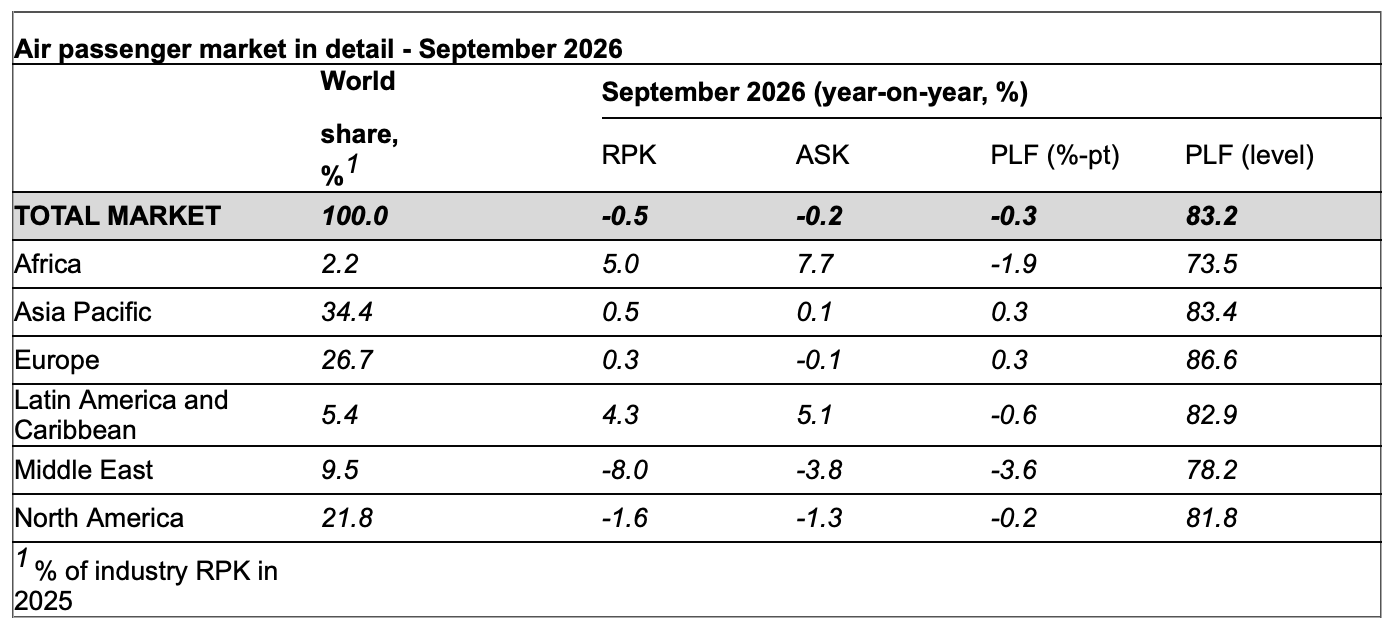
IATA’s September 2026 figures show total revenue passenger kilometres (RPK) dropped 0.5% compared with the same month a year earlier. Available seat kilometres (ASK) slipped 0.2%, resulting in a load factor of 83.2%, down 0.3 percentage points from September 2025. International demand rose 0.4%, while domestic demand fell 2.2%.
- RPK down 0.5% YoY
- ASK down 0.2% YoY
- Load factor 83.2% (-0.3 ppt)
- International demand +0.4%, domestic -2.2%
Regional Performance Highlights
Asia‑Pacific saw a modest 0.7% increase in demand and a 0.4% rise in capacity, with a load factor of 83.1%. Europe posted the strongest growth, with demand up 1.8% and capacity up 1.2%, lifting the load factor to 86.1%. The Middle East experienced the steepest decline, demand down 7.5% and capacity down 3.3%, leaving the load factor at 78.3%. Latin America and Africa both posted double‑digit demand gains of 8.2% and 8.0% respectively, accompanied by capacity increases of 7.6% and 8.8%.
- Asia‑Pacific demand +0.7%, load factor 83.1%
- Europe demand +1.8%, load factor 86.1%
- Middle East demand -7.5%, load factor 78.3%
- Latin America demand +8.2%, load factor 83.9%
- Africa demand +8.0%, load factor 74.8%
Outlook and Industry Commentary
Senior Vice President Sustainability and Chief Economist Marie Owens Thomsen noted that the September dip reflects ongoing geopolitical uncertainty and volatile fuel prices, but the return to growth in most international markets is encouraging. IATA expects scheduled seat capacity to stay above 2025 levels in October and November, although growth rates will remain weak and uneven across regions.
- Geopolitical uncertainty and fuel price volatility cited as drivers
- Capacity expected to remain above 2025 levels in Oct‑Nov
- Growth rates projected to stay weak and regionally unbalanced
What this means for travellers
Trip planning
- Existing bookings remain valid; no schedule changes are announced
- Travelers should monitor airline capacity updates for October and November
- No immediate fare adjustments are indicated by the traffic data
Cost and documents
- No new fees are introduced as a result of the traffic data
- Travel documents required for journeys stay unchanged
What you need to do
- Monitor airline announcements for possible capacity changes in coming months
- Consider flexible ticket options if traveling to regions with declining demand
Who this affects
-
Middle East travelers
Demand in the Middle East fell 7.5% year‑on‑year in September 2026
What to do No specific action required; monitor airline schedules
-
North American travelers
Demand in North America was flat while capacity fell 1.9% year‑on‑year
What to do No specific action required; watch for capacity adjustments
-
European travelers
Demand in Europe grew 1.8% year‑on‑year, with capacity up 1.2%
What to do No specific action required; opportunities may arise from stronger demand
-
Latin American travelers
Demand in Latin America rose 8.2% year‑on‑year, with capacity up 7.6%
What to do No specific action required; market shows robust growth
Frequently asked questions
Did global air passenger demand fall in September 2026?
Yes, global passenger demand fell 0.5% year‑on‑year in September 2026 according to IATA data, with a slight decline in load factor to 83.2%.
Which regions saw the biggest decline in passenger traffic in September 2026?
The Middle East experienced the steepest drop, with demand down 7.5% year‑on‑year, and the Middle East‑Asia corridor fell 8.8%, marking the deepest regional contractions.
Did any regions experience growth in September 2026?
Yes, Europe recorded a 1.8% increase in demand, Latin America grew 8.2%, and Africa rose 8.0% year‑on‑year, all supported by capacity gains.
What was the global load factor in September 2026?
The overall load factor was 83.2%, which is 0.3 percentage points lower than in September 2025.
What does IATA expect for seat capacity in October and November 2026?
IATA expects scheduled seat capacity to remain above 2025 levels during October and November, although growth will stay weak and uneven across different regions.
How did Asia‑Pacific demand change in September 2026?
Asia‑Pacific demand rose 0.7% year‑on‑year, capacity increased 0.4%, and the load factor was 83.1%, a modest improvement over the previous year.