Lilshira


3 Day Marrakech to Merzouga Itinerary: The Full Route
Back to articles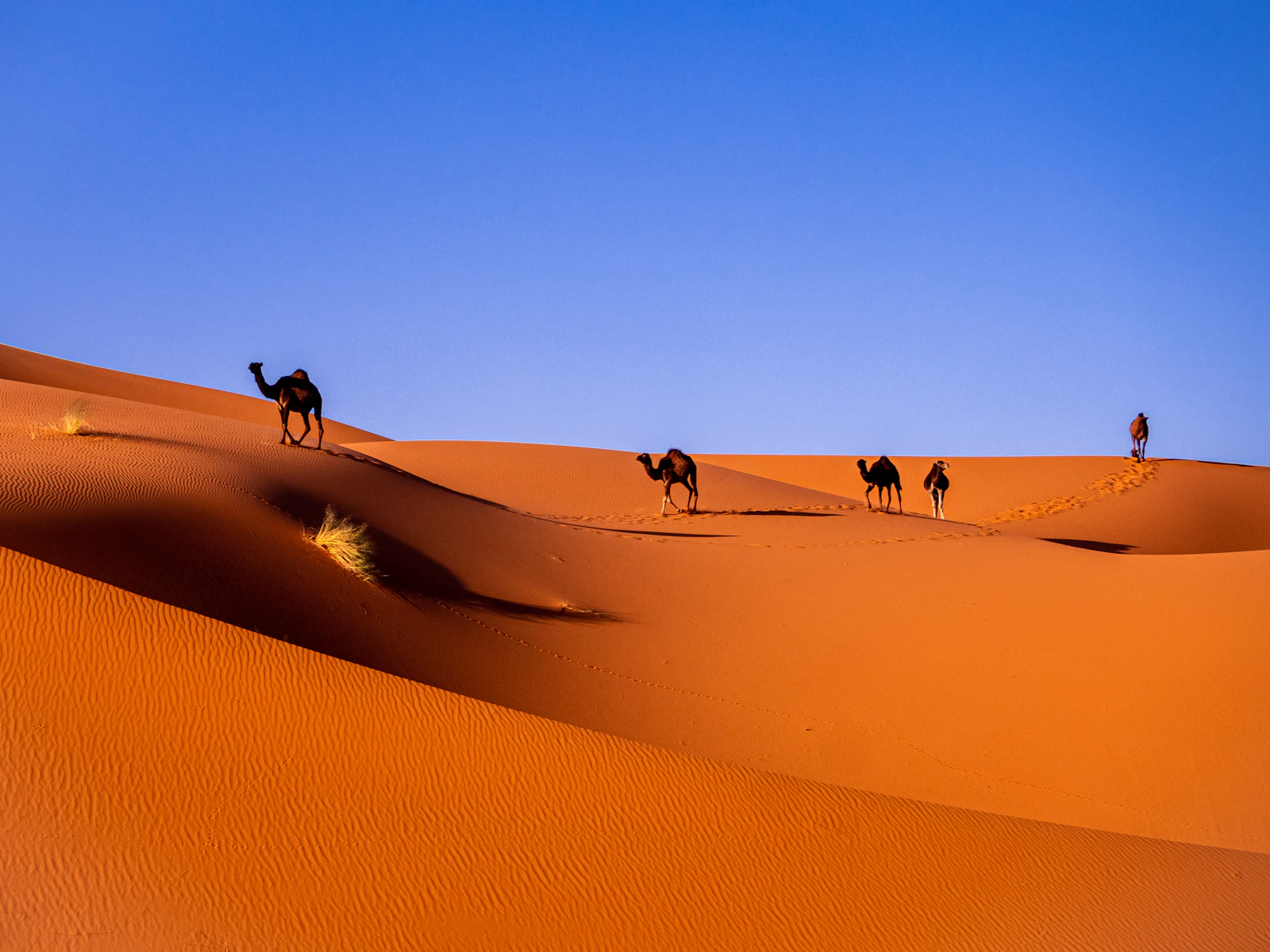
On this page
- What a 3 day Marrakech to Merzouga itinerary actually covers
- Marrakech to Merzouga distance, leg by leg
- Tizi n'Tichka and the crossing of the High Atlas
- The High Atlas to Sahara drive, stage by stage
- Night one on the Dades Valley route
- Day two: the Todra Gorge, Erfoud and the dunes of Erg Chebbi
- A night in a Merzouga desert camp, tier by tier
- Sunrise, the Draa Valley and the long road home
- Private driver, shared van or your own car: the honest trade-off
- How many Marrakech to Merzouga days you need: two, three or four
- Merzouga to Zagora: choosing between the two desert endpoints
- When to travel this route, and why the start time matters more than the month
- Frequently asked questions
A 3 day Marrakech to Merzouga itinerary is a driving loop: over the Tizi n'Tichka pass to Aït Benhaddou and the Dades Valley on day one, on through the Todra Gorge to the Erg Chebbi dunes on day two, and back through the Draa Valley on day three. It covers well over 1,000 kilometers of road in three days.
What a 3 day Marrakech to Merzouga itinerary actually covers
Three days and two nights is the shape of this trip, and distance decides it rather than anything there is to see. The road leaves Marrakech, crosses the High Atlas, follows the southern flank of the mountains through the Dades and Todra corridors to the Erg Chebbi dunes at Merzouga, and then returns. Night one is normally in the Dades Valley, night two at the edge of the sand.
Booking pages in Morocco almost all carry the same line, 3 days 2 nights, and it means two overnights and two very long driving days around one full day in the south. It does not mean three days of sightseeing. Realistically you get one afternoon and one early morning among the dunes, one gorge, one ksar, and a run of short stops chosen by the light.
The city is written both Marrakech and Marrakesh, and the two spellings mean the same place; road signs and airline systems each use whichever the printer preferred.
The sequence of stops is not a marketing decision either. Sand lies on the far side of the mountains, the only practical crossing runs through the Tichka pass toward Ouarzazate, and the road east from there passes the Dades gorge, the Todra gorge and the Tafilalet plain in that order, with nowhere else worth sleeping. The out-and-back version of the Marrakech to Merzouga route returns over the same pass; a smaller number of travelers carry on east to Fes instead, which shortens the last day and turns the trip into a one-way crossing.
For the days before and after the desert leg, the Marrakech city guide covers the medina itself.
Marrakech to Merzouga distance, leg by leg
Distance on this loop is the number that decides everything else about it. The one-way road distance from Marrakech to Merzouga sits in the region of 550 to 600 kilometers, and the full loop runs well past 1,000 kilometers. Leg by leg, it looks like this.
- Marrakech to Aït Benhaddou — roughly 180 to 200 kilometers, four to five hours including the pass and a stop.
- Aït Benhaddou to Ouarzazate — under an hour on a straight road.
- Ouarzazate to the Dades Valley — two to three hours, with the palm oasis at Skoura on the way.
- Dades Valley to the Todra Gorge — around two hours, the shortest driving morning of the trip.
- Todra Gorge to Merzouga — three to four hours across the plain through Tinjdad and Erfoud.
- Merzouga back to Marrakech, direct — eight to ten hours, comfortably the longest single stretch.
Two consequences follow. The return leg is close to a full working day, so a three-day trip gives you one desert evening rather than two, and the outbound journey is deliberately broken at the Dades instead of being pushed straight through. A direct run from Marrakech to Merzouga takes the best part of a day and drops you at the dunes after the light has gone, which is the whole reason the classic route sleeps in the valley.
Map distance also understates time on the road. Speed limits drop through every village, police checks sit on the main roads, the mountain section is slow whatever the traffic does, and fuel, lunch and photograph stops add an hour or more. Two things worth checking before you commit: whether your rental agreement caps mileage, and whether your insurance covers night driving.
Tizi n'Tichka and the crossing of the High Atlas
Above the tree line between Marrakech and Ouarzazate the road climbs to the Tizi n'Tichka, the main paved pass over the High Atlas, and the first day is arranged around it. Travelers type it as the Tizi n Tichka pass, sometimes with the apostrophes and sometimes without, and signs spell it in more than one way.
The pass tops out a little above 2,000 meters, and the climb is a long series of switchbacks that begins gently in argan and olive country and ends in bare rock. Trucks, coaches and cyclists all use it, and the descent on the far side runs for a long time before the landscape flattens toward Ouarzazate province. There is little at the top beyond a parking area, so the stops worth making are lower down, where the road looks back over the terraces it has just climbed through.
The pass is also the part of the route most likely to interrupt your plans. Between late autumn and early spring it can carry snow and ice, and closures of a few hours or a full day happen when the weather turns, with no alternative paved crossing anywhere close. Rockfall and roadworks cause shorter delays at any time of year, and the hairpins are not a place to be after dark, when the road surface is at its worst and there is no lighting.
Re-check before you travel, and again the day before you drive it: the current status of the road, the mountain forecast for the day of your crossing, and whether your driver or rental vehicle is equipped for winter conditions.
The High Atlas to Sahara drive, stage by stage
Day one is the longest of the three, and it decides whether the rest of the trip works, because every hour lost in the morning comes out of the dunes the next afternoon. The stops are in this order for reasons of light and geography rather than taste.
- Marrakech to the foothills. Start before the city traffic builds. The climb begins within the first hour; the hairpins arrive in the last third of the crossing.
- The pass and the descent. A short stop near the top, then the long drop toward Ouarzazate province as the country turns bare and red.
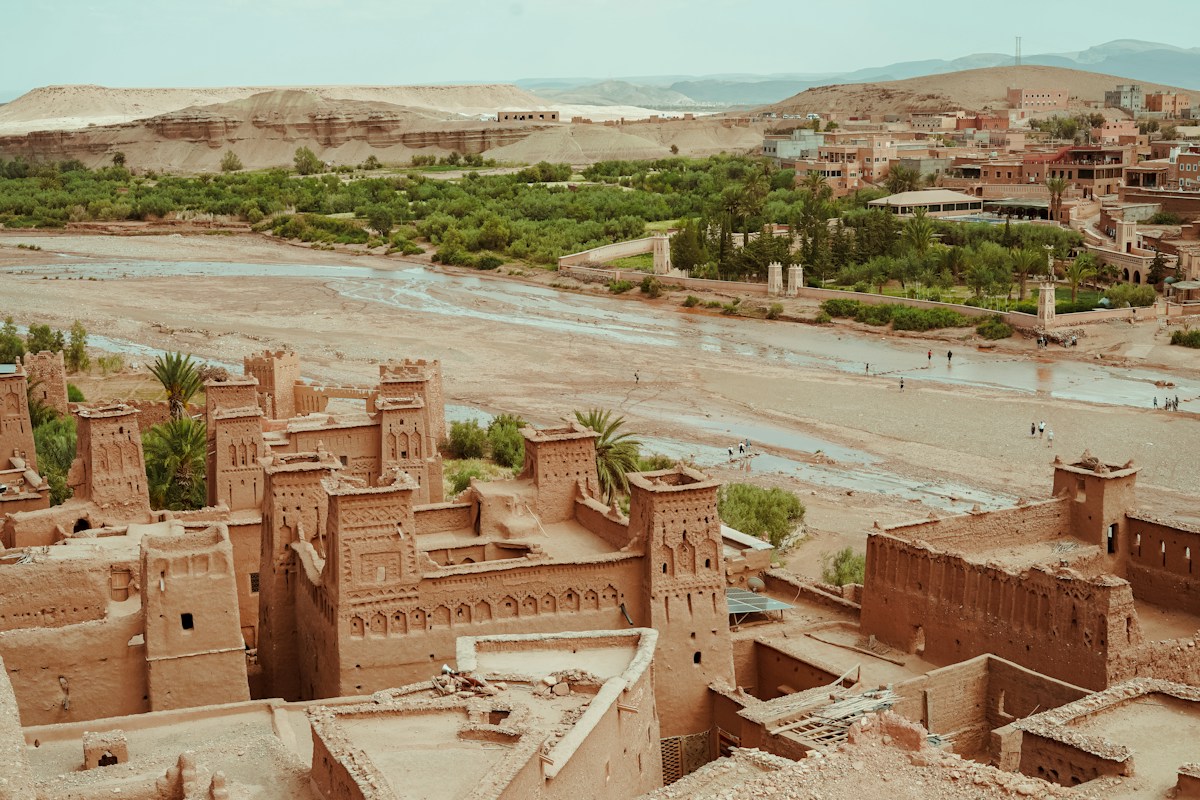
- Aït Benhaddou. An earthen ksar stacked on a hill above the river bed, with lanes you walk on foot and a climb for the view over the valley. An hour and a half is enough, two if you cross the river for the view back.
- Ouarzazate. Kasbah country and the film studios, and the point where the roads divide for the Draa and the Dades. Treat it as lunch and a leg stretch, or you will reach the valley after dark.
- Skoura. A long ribbon of palm oasis with kasbahs inside it. Half an hour on foot is enough.
- Kelaat M'Gouna. The rose-growing center of the valley, with roadside stills and, in spring, hedges of flowers along the road.
- Boumalne Dades. Where night one sits, on the gorge road above the valley floor.
The order is fixed by two things. The ksar is the only stop that needs daylight, because its lanes run between high walls and the point of it is the view from the top, so it belongs to the afternoon. Everything after it, the studios, the oasis and the rose valley, survives being trimmed. If you are behind schedule by Ouarzazate, cut there rather than at Aït Benhaddou.
Night one on the Dades Valley route
Night one is spent in the Dades Valley, a long trough running for tens of kilometers between the High Atlas and the Jebel Sarhro, and where you sleep inside it changes the morning. There are three sensible choices. Sleeping in Boumalne Dades puts you near fuel, a pharmacy and something open for dinner. Sleeping in one of the valley villages, in a small guesthouse or a kasbah-style hotel, is quieter and closer to the rock formations, but the road in and out is slow. Sleeping back in Ouarzazate is the fallback if you started late, and it costs an hour the next morning.
The valley is the standard overnight because of arithmetic. It splits the long first day and the long second day almost evenly, and it puts you within a short morning drive of the Todra Gorge, which is best walked before the heat arrives. It also leaves you on the gorge road above the valley at the end of the day, when the light is low.
Four things are worth confirming when you book: whether dinner is served on site, because a small valley guesthouse is often the only kitchen for kilometers; whether the room is heated, because winter nights here are cold and the buildings are not insulated; whether the gorge road suits your vehicle, since it is paved but narrow and steep; and what time you need to leave to reach the gorge before the coaches do.
Day two: the Todra Gorge, Erfoud and the dunes of Erg Chebbi
Two gorges, a plain and a dune field in one day sounds like too much, and it would be if the middle of the day were not mostly driving. The morning belongs to the Todra Gorge, the afternoon to the road across the Tafilalet, and the evening to the sand.
The Todra is a limestone canyon with walls that rise several hundred meters, a stream along the bottom and a road that narrows between the cliffs. You park at the mouth and walk in, which takes an hour at an easy pace; the canyon is short, and the point is standing at the bottom of it rather than covering distance. Longer walks go up onto the plateau above the gorge, and anything above road level is better arranged locally.
From there the road runs east through Tinjdad and Erfoud, past fossil workshops and date palms, across the plain that feeds the oases of the south. Erfoud is the last town of any size before the desert, and the usual place to buy water. Rissani, a little further on, is the market town at the gateway to the Tafilalet, and its market days are worth timing a trip around if you can find out when they fall.
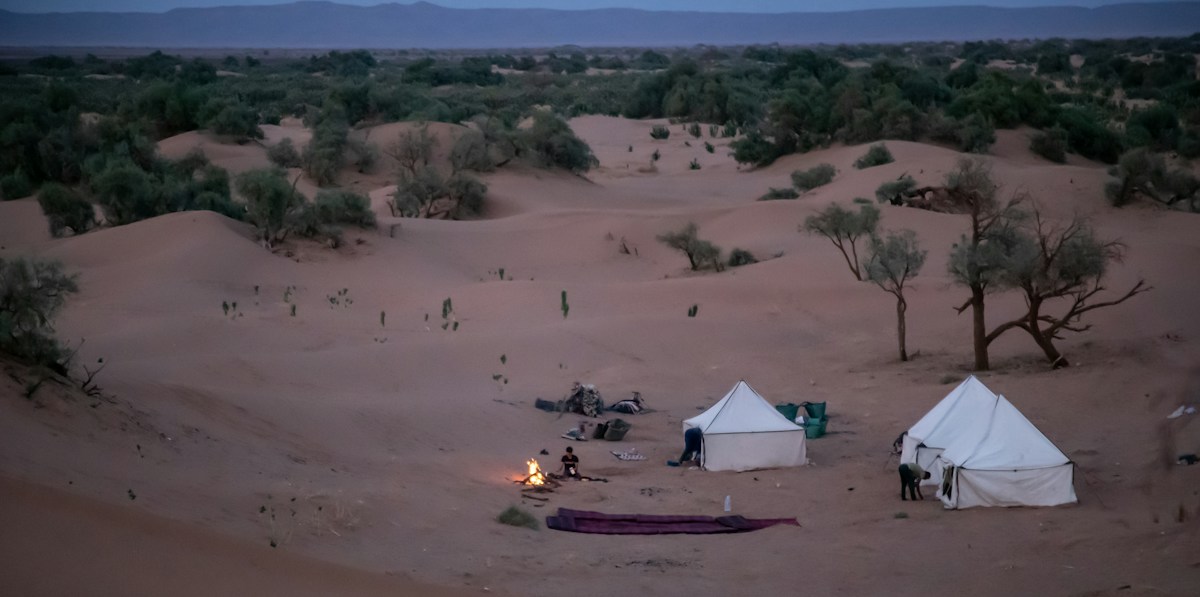
Merzouga arrives suddenly, because Erg Chebbi rises straight out of flat gravel. Vehicles stop at the edge of the sand, and the last stretch to the camp is done by camel or by 4x4. The camel trek is the standard arrival: an hour or so into the dunes in a slow line of animals led by a guide, with hand luggage only, since a suitcase stays in the vehicle. Late-afternoon light is what makes the dunes read as dunes, and the camp sits a short walk from wherever the camels stop.
A night in a Merzouga desert camp, tier by tier
Camps at Merzouga are sold in three broad tiers, and the tier matters more for how you sleep than the location does. The list below is what the labels mean, and what to check.
- Standard camp. Heavy fabric tents, mattresses on the floor with blankets, shared bathrooms a short walk away, dinner and drum music after it. The cheapest version and the coldest.
- Mid-range camp. Individual tents with a proper bed and better bedding, bathrooms still shared, sometimes a power point.
- Premium camp. Tents with en-suite bathrooms, running water in most, hot showers in many. This is the tier sold as luxury, and the one where the price gap is largest.
What does not change between tiers: dinner is included, breakfast is early, the dunes are immediately outside, and the camp empties onto the sand at sunrise. What does change is worth asking about in writing. How far is the camp from the road, because some sit at the edge of the sand and others need a 4x4 transfer of up to half an hour. Is the camel trek included or charged separately. Is the bathroom shared, and how many tents share it. Is there power in the tent. And how do you get out in the morning without the trek back.
You can sleep in a guesthouse in Merzouga village with a real bed, a shower and a power supply, and walk onto the dunes at dawn instead. Either way, bring layers, because outside the summer months the temperature drops hard after dark. The dunes at Erg Chebbi are a genuine dune field rather than a drift of sand, and the camp sits inside them.
Sunrise, the Draa Valley and the long road home
Sunrise over the dunes is the reason the third day exists, and it is the one part of the trip that nobody should skip. You climb a ridge before first light, watch the light come across the sand, walk back down for breakfast, and then start driving. Sleeping in the village instead of the camp does not change that, but it means leaving the room in the dark.
The route home is not a repeat of the outward road. From Merzouga the road runs through Rissani and Alnif, past the villages of Tazarine and Nkob, to Agdz at the mouth of the Draa Valley, then down the valley to Ouarzazate and back over the Tichka to Marrakech. The Draa is a corridor of palm oases with kasbahs standing in and behind the trees, and Agdz is the gateway to it. It deserves a full day on its own; on this schedule it gets a couple of stops and a lot of looking out of the window.
The alternative return is east, to Fes, through Errachidia and Midelt. It makes the third day shorter, ends in a different city, and skips the second crossing of the pass, which is why travelers who are continuing north usually take it.
Two practical notes. You will normally reach Marrakech after dark, and the last hour is on roads where unlit carts, mopeds and animals share the lane with you, so do not book a flight for that night. And if crossing the Tichka again in the dark does not appeal, add a night in Ouarzazate and drive the pass in daylight on the fourth morning.
Private driver, shared van or your own car: the honest trade-off
There are three ways to travel this route, and the difference between them is not comfort but who decides where the time goes. A shared departure is the cheapest seat, with fixed departures, fixed stops and a minibus of other travelers; it suits solo travelers and tight budgets. A private driver means you hire the vehicle and the driving, so the stops belong to you and the pace can stretch or shorten; it costs substantially more than a seat, and it suits couples, families with children, photographers and anyone who cannot manage long walks. Self-driving is a rental car and your own schedule. The whole loop is on paved roads, so a normal car is sufficient, but you need to be comfortable with mountain hairpins, city traffic, speed checks and the last hour in the dark.
The vehicle question is separate from the driving question, and this is where the 4x4 driver label gets used loosely. For the loop described here, four-wheel drive is not a requirement: the road to Merzouga is tarmac and a small diesel hatchback will cover the whole route on less fuel than anything else on it. A 4x4 earns its cost in four situations: if you want to sleep at a camp deeper inside the dunes, if you are extending to M'Hamid or Erg Chigaga, if you are taking side tracks into the Draa or the Dades, or if you are crossing in winter weather.
Whichever you choose, put the same four things in writing before you pay: the exact vehicle, the number of people sharing it, what the price covers, meaning fuel, tolls and the driver's own overnight, and the cancellation terms. If you would rather not arrange any of it, the private Marrakech to Sahara tour runs this loop with the driving handled for you.
How many Marrakech to Merzouga days you need: two, three or four
Between two and four days covers most trips, and the driving decides which one you need. Here is what each version gives you.
- Two days. Two long days in the vehicle, one desert evening, no gorge. It works only with a private vehicle and a very early start, and it leaves the middle of the route as a blur. Choose it if your dates are fixed, or drop the distance and go to Zagora instead.
- Three days. The standard: one night in the Dades, one at the dunes, one gorge, one sunset and one sunrise. It is the shortest version that does not feel like a transfer.
- Four days. The extra night buys either a second night at the dunes, so sunset and sunrise are not crammed around one camp night, or a night on the way back at Ouarzazate or in the Dades, which splits the eight-to-ten-hour return into two reasonable days. Take it if you want the Fes exit without a punishing final day, or if photography is the point.
- Five days or more. The extra days stop being about Merzouga and start being about the south: the Draa kasbahs, the Dades and the Todra at walking pace, a night inside the gorge rather than at its mouth, and a slower exit toward Fes or the coast. Longer versions of the same route are the 14-day Morocco cultural tour and the private eight-day Marrakech to Sahara tour.
The route needs two overnights to feel like a trip rather than a transfer, and no more than one of the three days should end in the dark. If you are weighing three days against four and the answer is not obvious, take four and spend the difference on the desert rather than on another city.
Merzouga to Zagora: choosing between the two desert endpoints
Zagora is the shorter desert trip, and the comparison with Merzouga is really a question about how far you are willing to drive for sand. The two are separate journeys rather than two stops on one route; Zagora is not on the Merzouga loop at all, and travelers comparing them usually mean which to choose.
Zagora sits at the southern end of the Draa Valley and is reached from Marrakech in one long day over the Tichka, through Ouarzazate and Agdz. That makes a two-day round trip practical, and it makes Zagora the answer for a short trip that still wants a desert night. The dunes there are low, more a drift of sand at the edge of the oasis than a dune field, and the reward of the route is the Draa itself: kilometers of palm gardens with kasbahs among them.
Merzouga is well over half again as far, which is why three days is the practical minimum from Marrakech rather than two. Erg Chebbi is a real dune sea, with ridges that run for tens of kilometers and faces high enough to feel like a landscape rather than a sandpit, and the camel trek and the camp night are the point of going.
A third endpoint lies beyond Zagora, at M'Hamid, where the road gives out and the dunes at Erg Chigaga are reached over tracks; it needs a 4x4, more days, and a tolerance for a rougher version of everything. One last clarification, because the two routes get confused: the Draa corridor serves Zagora and part of the return from Merzouga, but the destinations lie in different directions from Ouarzazate and are not interchangeable stops.
When to travel this route, and why the start time matters more than the month
Spring and autumn are the comfortable windows, and the season changes how the days are arranged rather than how many of them you need. In spring the days are mild, the desert nights are still cold, the rose valley is in flower, and a late cold snap is possible. In autumn the days are warm, the nights are cool and the pass is most reliable, but the camps are busiest, so book the camp before the vehicle. Summer rearranges the trip rather than cancelling it: you drive through the hottest hours, walk at the edges of the day, and reach the camp as it cools. Winter brings short days, cold nights in the dunes, and the one serious planning risk here: snow or ice closing the Tichka.
The thing that actually ruins the trip is not the month but the hour. A late start on day one means the ksar in flat light, Ouarzazate after dark and no view of the valley at all, and it pushes the whole deficit onto day two, where the time comes directly out of the dunes. Starting the desert day late has the same effect, because Erg Chebbi is only worth walking in the first and last hour of light.
Four things are worth re-checking in the week before you go: the status of the Tichka and the mountain forecast, camp availability in a peak week, whether your return day leaves margin before a flight, and the dates of Ramadan, which shift the rhythm of small towns and what is open during the day. For the country around this route, the Morocco destination page is the place to start, and if you are still deciding how long to give the city at either end, how many days in Marrakech answers that separately.
Frequently asked questions
Can you drive from Marrakech to Merzouga in one day?
Yes, but as a straight transfer rather than a day out. You would need to leave Marrakech before first light, drive the pass and both the Dades and the Todra corridors without stopping, and you would still arrive with the light going. Sleep one night and you are back on the road early the next morning. What you lose is everything between: the pass at leisure, the lanes of Aït Benhaddou and both gorges.
Do the camel trek and the desert camp come with the driver?
Usually not, even when a driver is taking you there. Confirm in writing what the driver covers, which is the vehicle, fuel, tolls and the driver's own overnight, and separately what the camp covers, which normally means dinner, breakfast and bedding but not always the camel trek. Find out which camp you are sleeping in before you pay, not on the day.
Can you do this route without a car or a driver?
It is possible but slow. Long-distance coaches and shared vans link Marrakech with Ouarzazate, the Dades Valley and Merzouga, and shared taxis fill the gaps between towns. What you lose is flexibility, because the transport runs to a timetable rather than to the light, and several camps cannot be reached without a transfer. Plan one stop fewer and accept arriving at some places at the wrong hour.
What should you pack for the desert night?
Layers, and more of them than you expect. Even in spring and autumn the temperature falls sharply after dark, and a camp provides blankets rather than heating. Bring a warm mid-layer, long trousers, something for the morning, a headlamp or a phone light, a refillable bottle and a power bank. Leave the large suitcase in the vehicle for the night, because camel treks carry hand luggage only.
Is there phone signal at the dunes?
Signal is unreliable once you leave the towns and often absent at the camps. Coverage is patchy between the Dades and Merzouga and effectively gone among the dunes themselves. Download offline maps and your booking details before leaving the main road, tell someone at home that you will be out of contact for a night, and do not count on being able to call from the camp.
What does the route cost, roughly?
Treat any figure as approximate and re-check it when you book, because the spread is wide. The variables are whether you take a shared seat, a private vehicle or a self-drive rental, and whether you sleep in a standard camp or a premium one with en-suite tents. Budget, mid-range and premium versions all exist on this route, and the total is driven more by the vehicle and the camp tier than by the number of nights.